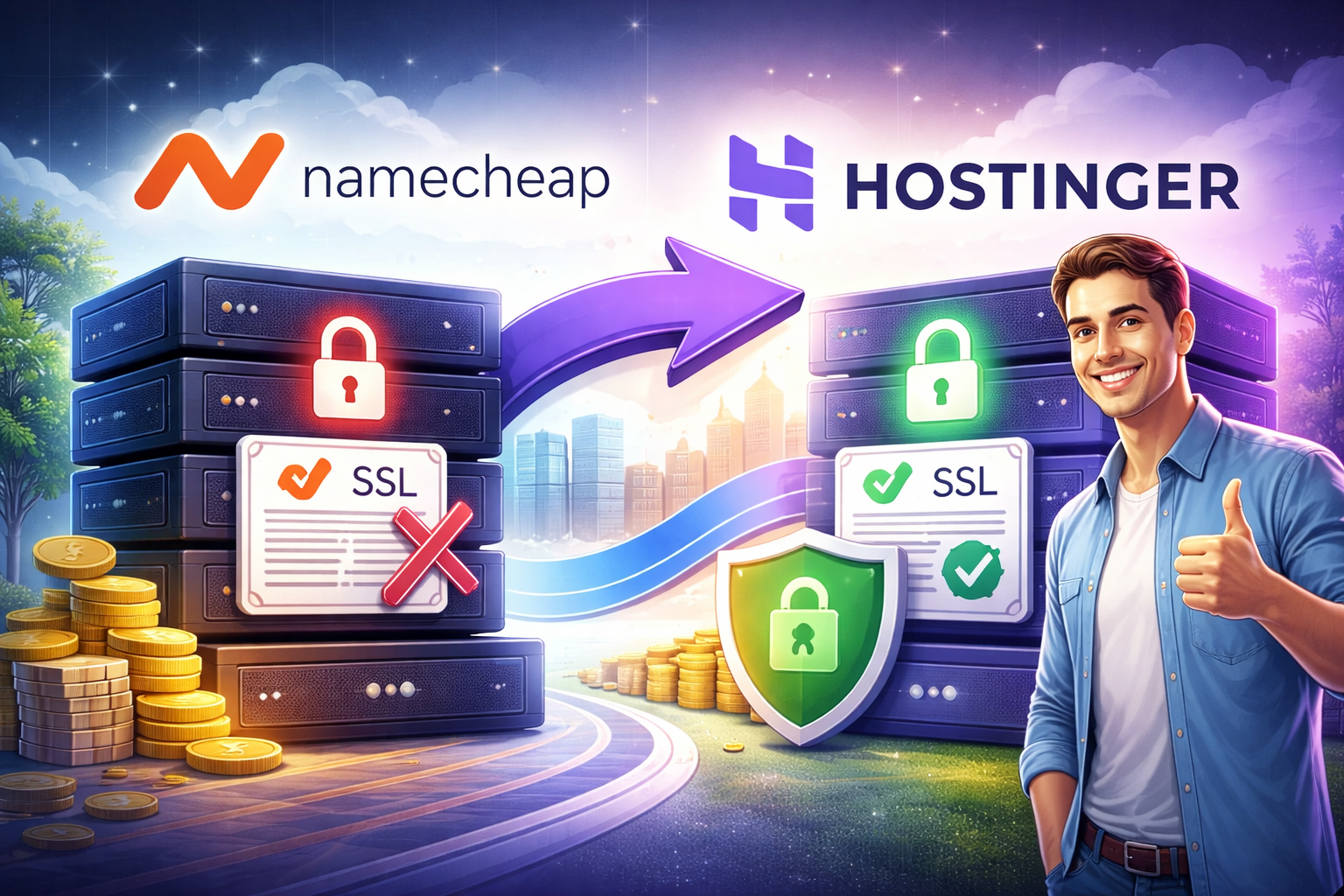
I want to share a real hosting decision I recently made — not because someone paid me to say it, but because it genuinely solved a problem that had been quietly frustrating me for years.
I used Namecheap for a long time. I still do — but only for domain registration now. I’ve officially moved my hosting to Hostinger, and the reason might surprise you:
👉 SSL certificates.
This post isn’t about specs or marketing buzzwords. It’s about one very practical pain point that finally pushed me to switch.
The Breaking Point: SSL Certificates That Cost Extra (Every Year)
If you own more than one website, you’ll probably relate to this.
Namecheap gives you:
- ✅ Free SSL included for the primary (main) domain
- ❌ Add-on domains only get free SSL for the first year — after that, you must pay for SSL and manually renew/set it up every year
At first, this doesn’t sound like a big deal. But over time, it becomes one.
Here’s what kept happening to me:
- I’d create a side project or small site
- It would be added as an add-on domain
- SSL would expire
- I’d forget to renew it
- Suddenly…
⚠️ “Not Secure” warning in the browser.
Nothing kills trust faster than that message.
Even worse, sometimes I wouldn’t notice right away — meaning visitors were seeing security warnings before I did.
That was the moment I realized:
I’m paying mental tax just to keep my sites secure.
Why “Not Secure” Is a Bigger Deal Than It Looks
Let’s be honest — most visitors don’t understand SSL details.
What they do understand is:
- Red warning text
- Broken padlock icons
- Browsers telling them “this site may not be safe”
Even if the site itself is harmless, the perception is damaging:
- Lower trust
- Higher bounce rates
- Worse SEO
- Lost credibility
For small sites, blogs, or side projects, paying yearly SSL fees for each domain just doesn’t make sense anymore.
What Finally Made Me Switch to Hostinger
When I looked into Hostinger more closely, one thing immediately stood out:
Every domain and every website hosted on Hostinger gets free SSL — forever.
Not just the main domain.
Not “one site only.”
Not “free for the first year.”
All of them. Automatically.
No renewals to remember.
No surprise “Not Secure” warnings.
No extra invoices.
That alone was enough to justify the move.
The Setup Experience (Surprisingly Smooth)
I expected migrating hosting to be a headache. It wasn’t.
What I liked:
- Clean, modern control panel (much simpler than cPanel chaos)
- Clear SSL status for every site
- SSL auto-installed and auto-renewed
- No upsell pressure every time I clicked something
Within a short time:
- All my sites showed the secure padlock
- No more reminders or calendar alerts
- No more “did I forget to renew something?”
That peace of mind matters more than most hosting features people argue about online.
What I Still Use Namecheap For (And Why)
To be clear:
I didn’t “break up” with Namecheap completely.
I still use them for:
- Domain registration
- Domain management
- DNS when needed
They’re solid at that.
But for hosting multiple websites, especially side projects and content sites, the SSL limitation was a deal-breaker for me.
Why I’m Recommending Hostinger Now
I only recommend tools I actually use — especially on my own websites.
Hostinger works for me because:
- 🔒 Free SSL forever on ALL domains
- 🌐 Perfect for multiple sites and projects
- 🧠 Less to remember, fewer things to break
- 💰 Better long-term value if you own more than one domain
If you’ve ever:
- Forgotten to renew an SSL
- Seen a “Not Secure” warning on your own site
- Paid yearly SSL fees for add-on domains
- Felt hosting was adding stress instead of removing it
…then Hostinger is worth a serious look.
My Recommendation (Affiliate Link)
If you want the same setup I’m using now, you can check out Hostinger here:
👉 [Get Hostinger hosting with free SSL on every site (affiliate link)]
(Using this link helps support my site at no extra cost to you — and I only recommend it because I actually moved my own hosting.)
Final Thought
Hosting shouldn’t be something you worry about every year.
For me, switching to Hostinger wasn’t about speed benchmarks or buzzwords — it was about eliminating a recurring, annoying problem that never should have existed in the first place.
No more expired SSLs.
No more “Not Secure” surprises.
No more unnecessary renewals.
Sometimes the best hosting choice is simply the one that lets you stop thinking about hosting at all.
About Author